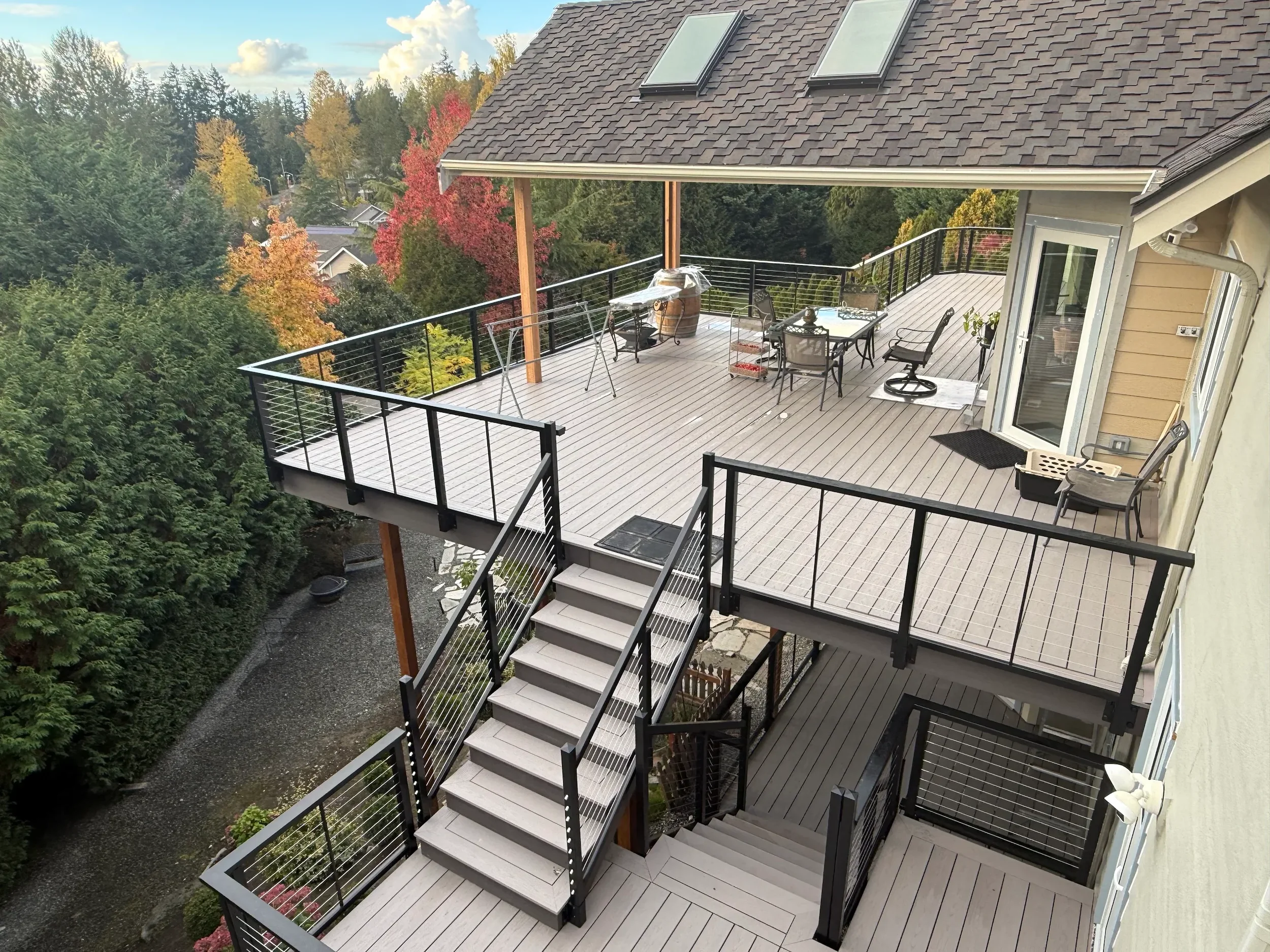
Timbertech Advanced PVC Fire Resistant Decking on multi-story deck built by Endura Decking Co
When homeowners in Sammamish, Bellevue, Issaquah, or anywhere around Seattle start planning a new deck, fire resistance usually isn't at the top of their list.
And I get it. We live in the Pacific Northwest, where we're typically more concerned about protecting our decks from rain, moisture, mold, and rot than we are about fire.
But something that often gets overlooked is how much fire we actually incorporate into our outdoor living spaces.
We build decks with outdoor kitchens, built-in grills, gas fire pits, fireplaces, and overhead heaters. These features make our outdoor spaces more enjoyable, particularly when we're trying to extend our outdoor living season into our cooler Northwest months.
That also makes the fire performance of the materials we use worth understanding.
One of the reasons I like working with TimberTech Advanced PVC decking is that certain collections offer excellent fire-resistance ratings, along with the moisture resistance, low maintenance, and realistic wood appearance that make them such a good fit for our area.
And with 12 color options across TimberTech's Class A-rated Advanced PVC collections, you don't have to compromise on appearance to make fire performance part of your material selection.
In this guide, you’ll learn:
What Class A fire-resistant decking actually means, and how it differs from ignition resistance and WUI compliance.
Which TimberTech decking collections offer the best fire performance, including Vintage, Landmark, and Harvest+.
How TimberTech Advanced PVC compares with traditional composite and wood decking, especially for Pacific Northwest conditions.
Which TimberTech colors and wood-grain finishes work best with different home styles and outdoor living spaces.
What to consider when adding outdoor kitchens, grills, fire pits, fireplaces, and heaters to your deck.
Why moisture resistance, low maintenance, and proper installation matter just as much as fire performance in the Seattle area.
Which TimberTech collection I'd recommend based on your budget, preferred appearance, and how you plan to use your deck.
Quick Answer: Is TimberTech Decking Fire Resistant?
Yes. TimberTech's Advanced PVC Vintage, Landmark, and Harvest+ collections all carry a Class A Flame Spread Rating, the highest surface flame-spread classification.
Vintage and Landmark also have an Ignition Resistant designation, and all three collections are listed as compliant with applicable Wildland-Urban Interface (WUI) requirements.
For homeowners in the Pacific Northwest, these products offer a compelling combination of fire performance, moisture resistance, realistic wood appearance, and minimal maintenance.
My recommendation: If you're building a premium deck, especially one that includes an outdoor kitchen, fire pit, fireplace, or overhead heaters, I'd start by looking at TimberTech Vintage or Landmark. Both offer excellent fire-related classifications, beautiful wood-grain finishes, and the durability we need in our wet Northwest climate.
Just remember that fire-resistant doesn't mean fireproof. Proper clearances, noncombustible materials where required, and thoughtful installation are still essential when incorporating cooking appliances or fire features into a deck.

Endura Decking Co outdoor living space built with firepit on TimberTech Advanced PVC Decking Vintage Mahoghany.
Why Fire Resistance Matters, Even in Rainy Seattle
Living in Western Washington, it's easy to assume fire-resistant building materials are primarily something homeowners in California or other wildfire-prone states need to think about.
But I look at it a little differently.
We're building more complete outdoor living spaces than ever before. What used to be a simple deck with a barbecue has evolved into an extension of the home.
Many of the projects we build at Endura Decking Co. include:
Built-in grills and full outdoor kitchens
Natural gas and propane fire pits
Outdoor fireplaces and fire tables
Gas and electric overhead heaters
Covered decks with finished wood ceilings
Outdoor lighting, electrical outlets, and entertainment systems
All of these features deserve thoughtful planning, and some introduce heat, flame, or ignition risks.
We also have plenty of wooded properties throughout Sammamish, Issaquah, North Bend, and the surrounding Eastside communities. While our climate is generally wet, we still experience dry summer conditions, and many homes sit close to trees and other vegetation.
That doesn't mean every homeowner needs to build a wildfire-rated deck. But when you're investing in a new outdoor living space that connects directly to your house, I think it's worth considering the fire performance of the materials you're putting against it.
What Does a Class A Flame Spread Rating Actually Mean?
This is where the terminology can get a little confusing.
A Class A Flame Spread Rating means a material performed within the highest flame-spread classification in a standardized test, such as ASTM E84. It doesn't mean the material cannot catch fire.
It's also important to understand the difference between three commonly mentioned ratings.
Class A Flame Spread Rating
This evaluates how flames spread across a material under standardized test conditions.
Class A is the highest classification and indicates relatively low surface flame spread.
Ignition Resistant Designation
This is a separate classification for materials tested to resist ignition or sustained burning under specified conditions.
TimberTech's Vintage and Landmark Advanced PVC collections carry this designation in addition to their Class A ratings.
WUI Compliance
WUI stands for Wildland-Urban Interface, which describes areas where development meets or mixes with wildland vegetation.
WUI compliance generally addresses building-material performance under wildfire-related exposures, but the actual approval requirements vary by jurisdiction and product configuration.
TimberTech identifies Vintage, Landmark, and Harvest+ as WUI-compliant collections.
The important distinction: none of these ratings makes a deck fireproof or eliminates the need for proper installation, clearances, and fire-safe design.
Which TimberTech Decking Collections Offer the Best Fire Resistance?
TimberTech offers several decking collections, but they don't all have the same fire ratings.
If fire resistance is an important part of your material decision, these are the three Advanced PVC collections I would start with.
1. TimberTech AZEK Vintage Collection — My Preferred Premium Choice
Fire performance: Class A Flame Spread Rating, Ignition Resistant designation, and WUI compliance.
The Vintage Collection is one of my favorite decking products, and we use it regularly on our custom deck builds.
It has an exceptionally realistic hardwood appearance, rich color variation, and a refined wire-brushed texture. It also offers multiple board-width options for more customized deck layouts.
Available colors include:
Coastline
Weathered Teak
Cypress
Mahogany
English Walnut
Dark Hickory
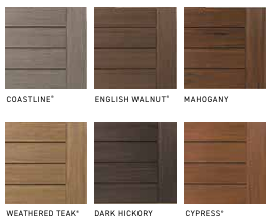
TimberTech Vintage Collection Deck Color Options
One combination I really like is Coastline decking with a Dark Hickory or English Walnut picture-frame border. It creates a clean, modern look while adding enough contrast to make the details stand out.
For homeowners who prefer warmer wood tones, Mahogany, Cypress, and Weathered Teak are excellent options.
Because Vintage is an Advanced PVC product without wood fibers, it also offers excellent resistance to moisture damage, mold, mildew, and rot. Those are major advantages in our climate.
My recommendation: Vintage is usually where I start when a homeowner wants premium appearance, long-term durability, and the strongest combination of TimberTech's listed fire-related designations.
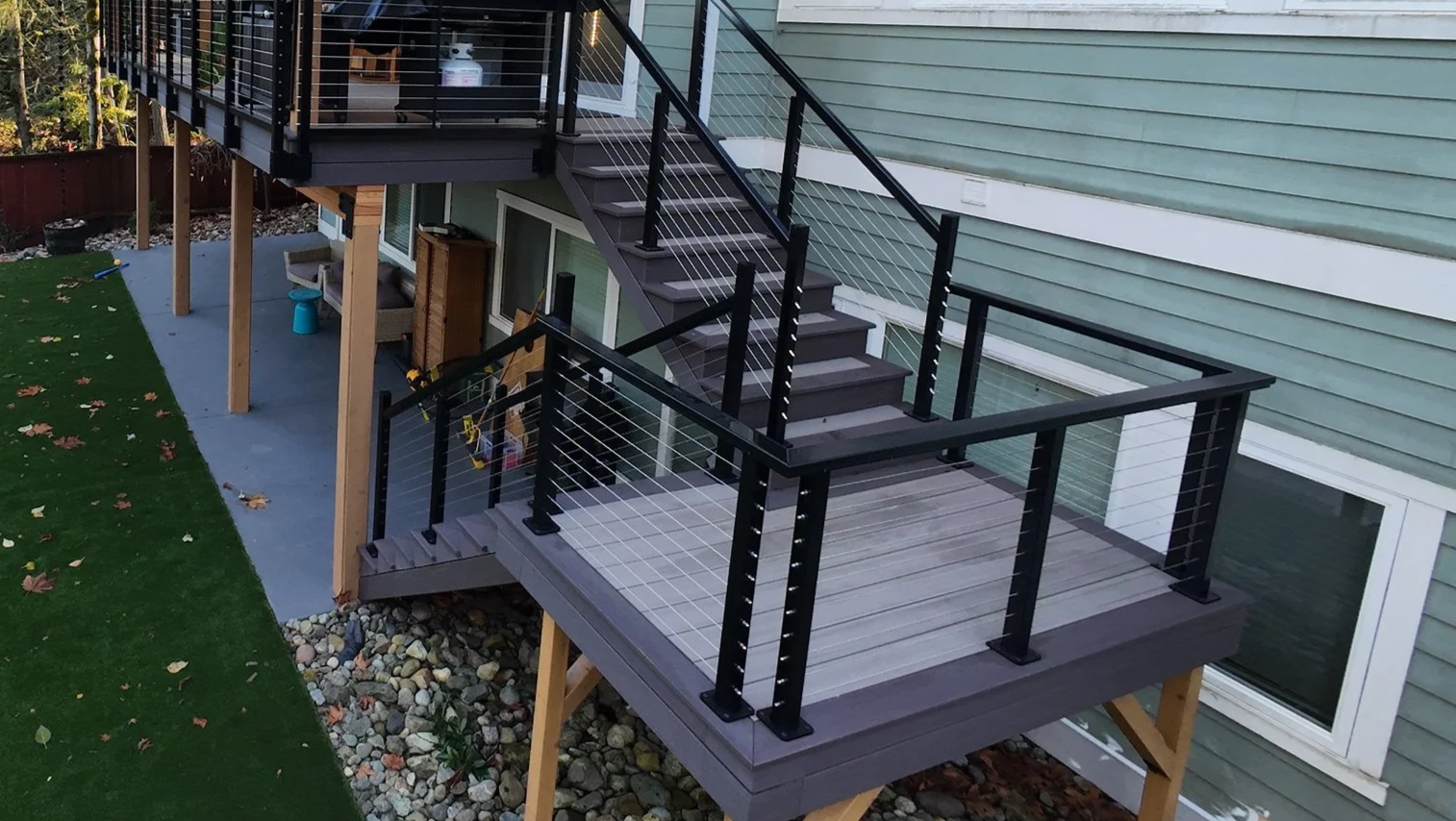
Endura Decking Co project installing Timbertech Advanced PVC Vintage Collection with Dark Hickory picture frame border and Coastline.
[IMAGE: Actual Endura project using TimberTech Vintage Coastline with Dark Hickory picture-frame border, preferably showing the deck surface and railing.]
2. TimberTech Landmark Collection — Best for Distinctive Hardwood Character
Fire performance: Class A Flame Spread Rating, Ignition Resistant designation, and WUI compliance.
Landmark offers the same three fire-related classifications as Vintage, but with a different visual style.
Rather than the wire-brushed exotic hardwood appearance of Vintage, Landmark features a more pronounced crosscut grain inspired by oak and walnut.
The four colors are:
French White Oak
American Walnut
Castle Gate
Boardwalk
I especially like the idea of Landmark for homeowners who want their deck to complement a contemporary, transitional, or modern farmhouse-style home.
French White Oak and Boardwalk offer lighter, more understated options, while American Walnut and Castle Gate provide deeper contrast.
My recommendation: If you like the fire-performance characteristics of Vintage but want a more distinctive oak or walnut grain pattern, Landmark is worth comparing side by side.
3. TimberTech Harvest+ Collection — A Strong Value Alternative
Fire performance: Class A Flame Spread Rating and WUI compliance.
Harvest+ offers an attractive alternative for homeowners who want high-performance PVC decking and a Class A rating but don't necessarily need the same premium appearance or additional ignition-resistant designation found with Vintage and Landmark.
It features subtle cathedral grain, natural-looking tonal variations, and a softer, weathered hardwood appearance.
Available colors include:
Toasted Wheat
Timber Gray
Both work well with the exterior colors we commonly see around the Seattle Eastside.
I particularly like the idea of Timber Gray on a modern Northwest home with black aluminum or cable railing. Toasted Wheat would look great with natural cedar, warm siding, and stone accents.
My recommendation: Harvest+ deserves consideration if your priority is Class A-rated Advanced PVC decking with understated styling at a lower product price tier than Vintage or Landmark.
TimberTech Fire-Resistant Decking Comparison
What About TimberTech Composite Decking?
One point I like to explain to homeowners is that TimberTech Advanced PVC and TimberTech composite decking are not the same material.
Advanced PVC contains no wood fibers. Composite decking generally combines recycled wood fibers and polymers, with protective capping that varies by collection.
Both have their place.
We regularly recommend composite products like TimberTech Terrain+, Legacy, and Prime+ depending on the homeowner's budget, preferred colors, and the type of project.
But if a homeowner specifically asks me to prioritize moisture resistance and the strongest fire-related classifications in TimberTech's lineup, I generally point them toward Advanced PVC Vintage or Landmark first.
That doesn't mean every composite product performs poorly in a fire. It simply means you shouldn't assume that every TimberTech board carries the same flame-spread or ignition-resistant rating.
Can You Put a Grill, Fire Pit, or Outdoor Heater on TimberTech Decking?
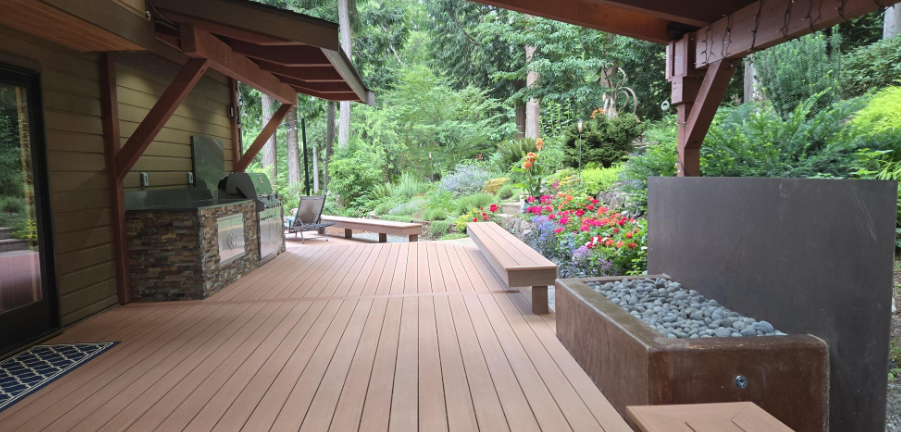
Timbertech Advanced PVC with cooking appliances and fire features.
This is probably the most practical question homeowners have once they learn about fire-resistant decking.
The answer depends on the appliance, how it's installed, the required clearances, and the surrounding deck construction.
A fire-resistant decking board is not a substitute for proper fire-feature design.
Outdoor Grills and Kitchens
A freestanding grill may be suitable for a TimberTech deck when the grill manufacturer's requirements and the decking manufacturer's recommendations are satisfied.
Built-in grills require additional consideration, including heat shielding, ventilation, noncombustible components, and appropriate separation from nearby materials.
I prefer to work through those details during the initial design rather than trying to squeeze a large outdoor kitchen into a finished deck later.
Gas Fire Pits and Fire Tables
Gas fire pits and fire tables can create beautiful outdoor living spaces, but they need to be selected and positioned carefully.
Some models are listed for installation on combustible deck surfaces under specific conditions. Others aren't.
For built-in fire features, we can incorporate noncombustible materials such as stone, concrete, or other approved assemblies where required.
Outdoor Fireplaces
Fireplaces introduce another level of design considerations, including the firebox, chimney or venting system, surrounding materials, and clearances.
This is especially important when the fireplace is integrated into a covered outdoor living space.
Overhead Gas and Electric Heaters
Overhead heaters are one of my favorite additions to covered decks in the Pacific Northwest.
They extend the usable season and make a space considerably more comfortable during cooler evenings.
But overhead heaters require careful planning around ceiling materials, roof framing, wiring or gas connections, and heat clearances.
We often integrate these systems into covered outdoor spaces, and the placement matters just as much as the heater itself.
My advice: If you're planning any of these features, let your deck builder know before finalizing the design. It's much easier to accommodate proper framing, fire-resistant assemblies, utilities, clearances, and finishes from the beginning.
For more details, see our guide: Fire Features for PNW Decks: Gas vs. Electric, Costs & Design Options.
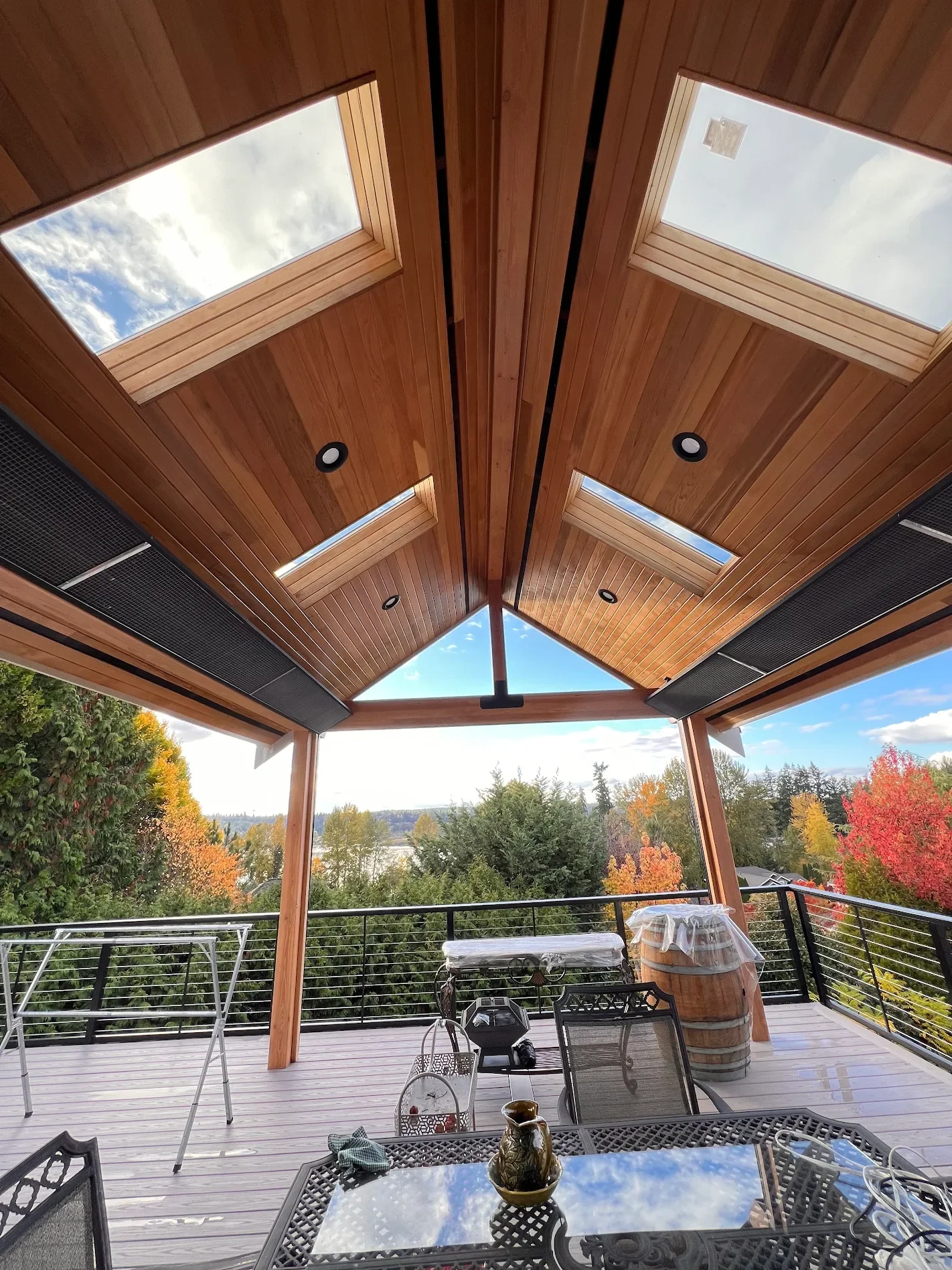
Endura Decking Co project with Timbertech Advanced PVC and two 17’ IR Energy Eventube Gas Ceiling heaters installed in black.
Why TimberTech Advanced PVC Is Such a Good Fit for Pacific Northwest Homes
Fire resistance is an added benefit, but it's not the only reason I recommend TimberTech Advanced PVC.
For most of our clients, the bigger issue is how well the decking will perform over years of exposure to rain, shade, moisture, and changing temperatures.
Exceptional Moisture Resistance
Traditional wood decking absorbs moisture, which can contribute to swelling, checking, splintering, and eventual decay.
TimberTech Advanced PVC doesn't contain wood fibers, making it highly resistant to moisture-related deterioration.
That's especially valuable on shaded properties, wooded lots, and decks that receive very little direct sunlight during our wetter months.
Less Maintenance
One of the most appealing things about PVC decking is that homeowners don't need to sand, stain, or seal it every few years.
It still needs occasional cleaning, particularly when leaves, pollen, and organic debris accumulate, but the ongoing maintenance is considerably different from natural wood.
Realistic Wood Appearance
This is an area where premium decking has improved dramatically.
TimberTech's color blending, grain textures, and board profiles provide an impressive hardwood appearance without requiring the same upkeep as traditional wood.
We can also combine complementary colors for picture-frame borders, breaker boards, stair details, and custom layouts.
Long-Term Warranty Protection
TimberTech Advanced PVC is backed by a Limited Lifetime Product Warranty and a 50-Year Fade & Stain Limited Warranty, subject to the manufacturer's terms and exclusions.
It's one of the reasons I feel comfortable recommending these products for long-term investments.
Better Choices for Bare Feet and Outdoor Living
Advanced PVC is splinter-free and designed to provide good traction, including in wet conditions.
TimberTech also offers cooler-to-the-touch performance compared with certain competing composite decking products, although all decking can become hot in direct sunlight, especially darker colors.
These may seem like small considerations, but they affect how comfortable and enjoyable your deck is to use every day.
The Decking Is Only One Part of a Fire-Conscious Design
Something I've learned from building custom outdoor spaces is that the finished decking surface is only one part of the project.
You also need to think about the structure underneath and everything surrounding it.
That includes framing, railing, siding, soffits, roof structures, wiring, gas lines, vegetation, and even what might accumulate beneath the deck.
A Class A-rated deck board doesn't automatically make the entire deck assembly fire-resistant.
For projects where fire performance is a particular concern, we can also evaluate noncombustible materials, including metal railing and appropriate framing systems.
Just as important, we pay close attention to the structural and moisture-protection details that make a deck last in the Northwest.
A premium decking board isn't going to compensate for poor framing, improper flashing, inadequate drainage, or careless installation.
That's why we take a structural-first approach at Endura Decking Co.
Which TimberTech Decking Would I Choose for My Own Home?
If I were building a new deck for my own home here in the Pacific Northwest, TimberTech Vintage would be near the top of my list.
I really like the combination of realistic hardwood appearance, moisture resistance, available design options, and its fire-related classifications.
For a modern home, I'd probably lean toward Coastline with a darker picture-frame border. For something warmer and more traditional, I'd strongly consider Weathered Teak, Cypress, or Mahogany.
But I wouldn't tell every homeowner they need to buy the most expensive product.
If someone preferred the grain of Landmark, I'd be comfortable recommending it as another premium option.
And if the goal was to keep the investment more manageable while still getting Class A-rated Advanced PVC, I'd look closely at Harvest+.
The right answer depends on your home, your budget, and how you plan to use your outdoor space.
Final Thoughts: Build for More Than Just the Rain
We spend a lot of time thinking about water when we build decks in the Pacific Northwest—and for good reason.
But I believe a well-designed outdoor living space should account for more than just our rainy weather.
It's also worth thinking about fire performance, heat-producing appliances, long-term durability, maintenance, and the materials that connect your outdoor space to your home.
TimberTech's fire-resistant Advanced PVC collections give homeowners some excellent choices without sacrificing appearance.
And with the right planning, you can create an outdoor space that looks great, works for how your family actually lives, and is thoughtfully built for the years ahead.
Thinking About a New TimberTech Deck or Outdoor Living Space?
I'm Steve Peck, owner of Endura Decking Co. We build custom decks, covered outdoor living spaces, outdoor kitchens, and complete deck replacements throughout Sammamish, Bellevue, Issaquah, Redmond, Mercer Island, and the surrounding Seattle Eastside.
If you're considering TimberTech Advanced PVC, I'd be happy to walk through the different collections, show you real material samples, and help you decide what makes sense for your home.
Contact me to schedule a free deck consultation
Check out our gallery and social channels for pictures, updates and upcoming events.
Instagram | Facebook | YouTube | Read our reviews
Frequently asked questions about TimberTech Fire-Resistant Decking
Is TimberTech decking fireproof?
No. TimberTech decking is not fireproof. Certain Advanced PVC collections have Class A Flame Spread Ratings, and the Vintage and Landmark collections also carry an Ignition Resistant designation. These classifications indicate performance under specified tests, not immunity to fire or heat damage.
Which TimberTech decking is the most fire-resistant?
TimberTech Vintage and Landmark are my first recommendations when fire resistance is a primary consideration. Both have a Class A Flame Spread Rating, an Ignition Resistant designation, and WUI compliance. Harvest+ also has a Class A rating and WUI compliance but does not list the additional ignition-resistant designation.
Is PVC decking better than composite decking for fire resistance?
Not automatically. Fire performance depends on the specific product and its tested rating, not simply whether it's PVC or composite. However, TimberTech's Vintage and Landmark Advanced PVC collections offer a particularly strong combination of fire-related classifications within the TimberTech lineup.
Can you put a gas fire pit on TimberTech decking?
Some gas fire pits and fire tables may be approved for certain deck installations, but that depends on the appliance and applicable requirements. Never assume a Class A-rated deck can safely support any fire pit. Verify the appliance's listing, clearances, heat protection, and installation instructions.
What is the best decking for rainy Seattle-area homes?
I frequently recommend TimberTech Advanced PVC because it contains no wood fibers, resists moisture-related damage, and requires no regular staining or sealing. Vintage, Landmark, and Harvest+ are all worth comparing for homeowners in Sammamish, Bellevue, Issaquah, Redmond, and other Western Washington communities.
Does TimberTech decking get slippery when wet?
TimberTech Advanced PVC offers traction designed for wet and dry conditions, making it an attractive option for our rainy climate. However, any decking can become slippery when leaves, moss, algae, or other organic buildup are allowed to accumulate. Regular cleaning is still important.
What TimberTech decking colors are best for Pacific Northwest homes?
Coastline, Weathered Teak, Cypress, Mahogany, Dark Hickory, and English Walnut are popular choices worth considering in the Vintage Collection. Lighter tones often complement contemporary homes, while deeper wood colors can work beautifully with natural cedar, stone, and traditional Northwest architecture.